
In Conversation with Adele van Heerden on her solo exhibition Alluvial, at 131 A Gallery
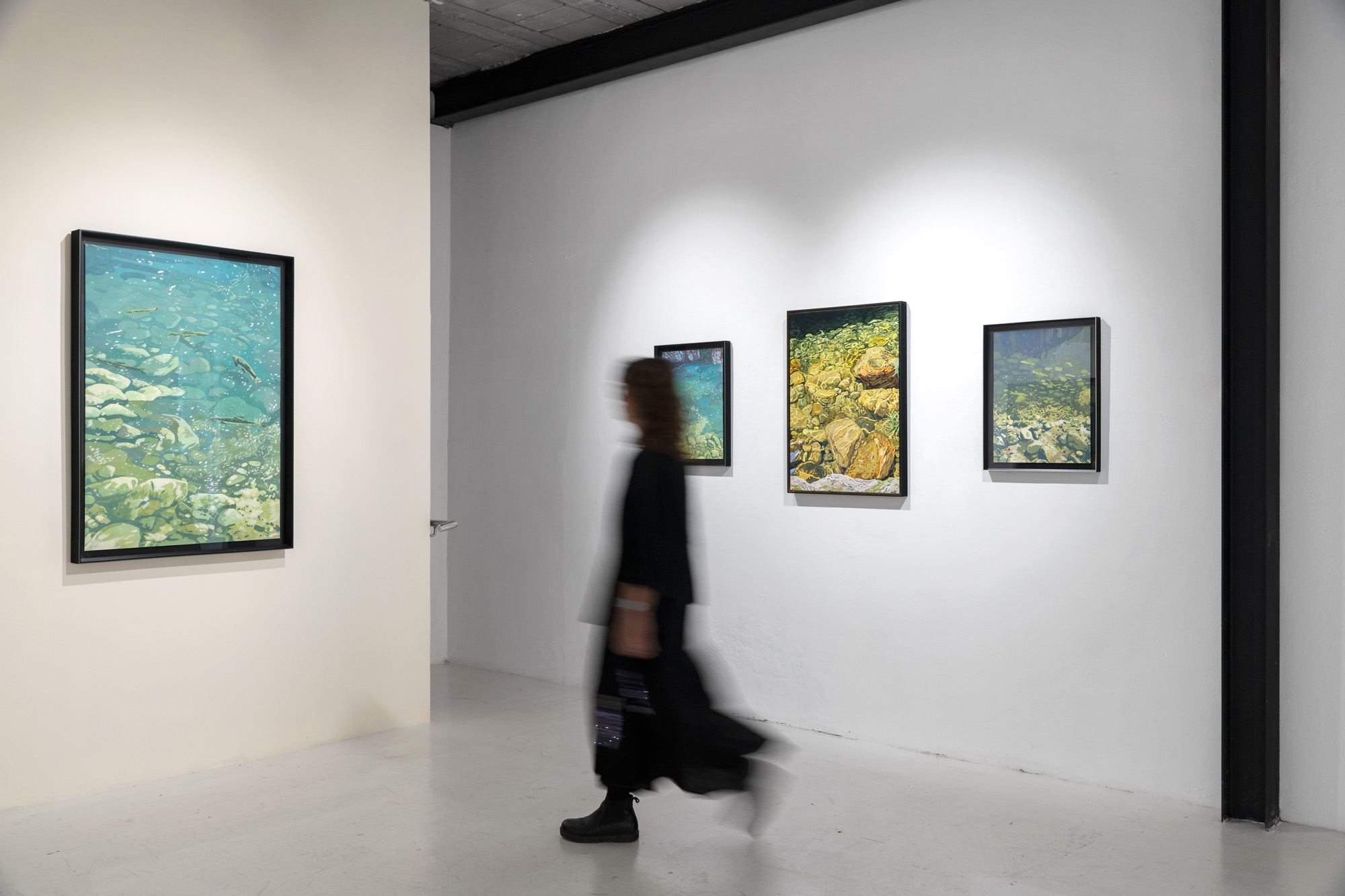
Installation shot, photo by Paris Brummer
Latitudes’ Junior Content Producer, Palesa Ngwenya, sat down with Adele van Heerden following the opening of her new solo exhibition at 131 A Gallery to talk through the ideas and sensibilities shaping her new body of work.
Adele Van Heerden continues to dedicate herself to the interplay between light, water and natural life, as she celebrates the freedom that comes with a healing body and the ceremonial act of swimming. Van Heerden’s adventurousness is rewarded with the sensations that accompany the disintegration of the real and imagined boundaries between human and waterbodies. Audiences join Van Heerden by the riverbed, where rushing water flushes the river’s veins and Alluvial matter sets the scene for the artist’s latest solo exhibition. Here, there are rich soils, an earthier palette, and an investigation into a river’s teachings on time. The channel of water carries and collects the fertile sediment, that feeds the aquatic environment’s soil.

Adele Van Heerden, portrait, by Paris Brummer
Moving away from urbanised environments that engage with bodies of water on the city’s coastlines, the artist’s focus has moved towards a metaphorical space rather than a specific, physical location. Turning her gaze onto rivers and their symbolic and subconscious provocations, Van Heerden finds new moments of connection to encapsulate as she traverses the Cederberg mountains, where ancient formations rest 200 kilometres outside of Cape Town. The artist’s creative practice is discretely defined by an amorphous understanding of the ‘waterbody’. There, with the dazzle of specular reflection’s dancing, the artist reconsiders the distinctions made between internal and external landscapes with pastel, gouache and aerosol on her preferred canvas of architectural film paper. Each series of artworks brings Van Heerden closer not only to herself, but to a greater and deeper sense of knowing that recalibrates her perspective. What can seem as simple as a ‘trick of light’, can in fact lead one, through curiosity and witness, to profound revelations.
Let's step into the world of Adele Van Heerden!
------------------------
LO: What first sparked the inspiration for Alluvial as a body of work, and how did the title emerge from that process?
A: The inspiration for Alluvial was first sparked from a visit to the Olifants River in the Cederberg. Upon arriving, I discovered golden fish swimming in the stream, which I later discovered are the Clainwilliam Yellowfish, which are only found in tributaries of that river system. I learned the species is near-threatened due to bass being introduced in the 1940’s -1970’s, along with canalisation, damming and water pollution.
Learning more about the Clainwilliam Yellowfish compelled me to do some research about river systems and the phenomena of Alluvium (from Latin ‘to wash against’). This refers to sediments deposited underwater, in streambeds, seas, estuaries, lakes, or ponds. Alluvial soil can be very fertile, and is associated with gold found in rivers, often hiding underneath mud and debris. When I think of Alluvial, I think of the gold that can be hidden there beneath layers of sediment and mud.

LO: In your artist statement, you write that “there is an investigation into a river’s teachings on time,” and a continued dedication to the interplay between light, water, and natural life in this show, as well as a celebration of the freedom that comes with a healing body and the ceremonial act of swimming. Could you walk us through what this means to you and what you hope the audience will take away from the show?
A: In my work there always seems to be an interchange between memory, identity and the natural world. In the second half of this year, I started walking in the mountains again for the first time in years due to an injury, often next to rivers, and would sometimes involve swimming in them. I learned a lot about myself from engaging with water. I read a story called Memory River by Marchelle Farrell, after which I came to see the river as a metaphor for time and self-discovery. According to Farrell, Memory flows like a river, and it is through this forward-rushing motion that we come into being. Experience continually alters the terrain of the self, carving bedrock, laying down silt, and creating new, fertile ground. Our inner life is a landscape shaped by time– an ever-advancing current of the present.
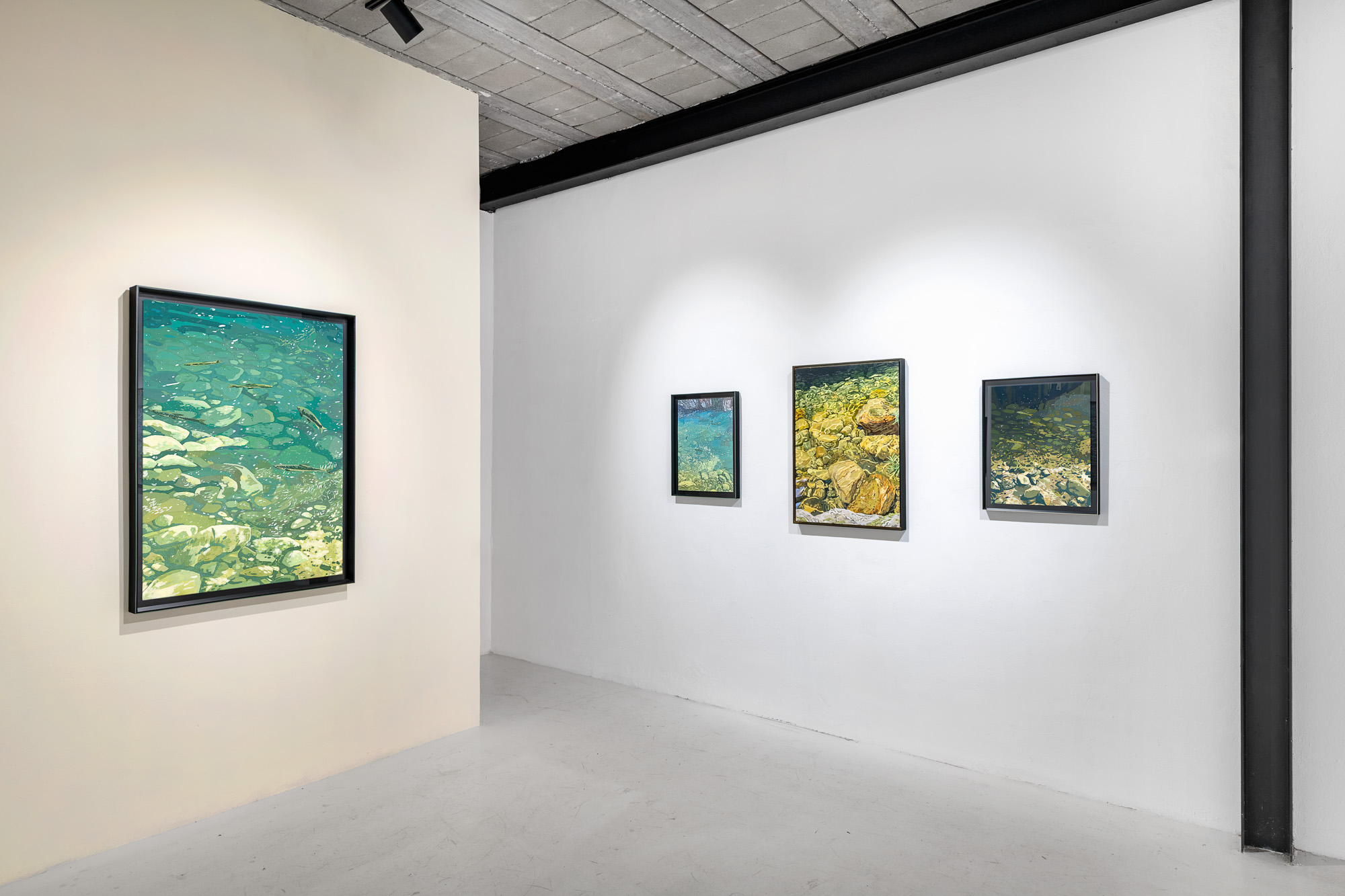 Installation shot, photo by Paris Brummer
LO: Which of the artwork(s) from this show are you most excited for people to see, and why? What about them feels significant to you?
A: I think there has been a significant shift in the way that I paint. I started being more strategic and taking more time to consider decisions in between steps in the process. I thought a lot about how pastel and aerosol application in combination with my reverse-painting technique could more effectively depict the depth of sediment layers, the movement of water and the ways in which light interacts with it (‘Particle Motion’, ‘Lacuna’, ‘Source’).
I've recently also begun working on linen and am very pleased with the results. I'm using my usual gouache painting technique and then applying a glaze with oil paint to add depth and colour richness (such as in ‘Becoming’). This feels very exciting, and I can see myself working more towards this direction in the future.

Adele Van Heerden, Particle Motion, 2026, CONTACT TO BUY.
LO: In what ways does Alluvial speak to, or perhaps shift away from, your previous shows like Prism and Signal?
A: In Alluvial, I am more interested in the patina hues of rivers, rather than the typical blue and turquoise found in chlorinated pools. I think there is a shift in my own being. I feel more myself, more centred than I have been in the past. I think this comes through in my work - there is a feeling of fullness, having found something, of being where I need to be.
I see water as a teacher and try to live the same way: without a fixed identity, in flux, and always in a state of becoming. Realising that I am queer, that my identity is fluid, expanded both my sense of self and my practice.

Adele Van Heerden, Becoming, 2026, image courtesy of Adele Van Heerden.
LO: Did your direction for Alluvial change at any point during the creative process, and did you gain any new insights that differed from your previous projects?
A: I think at some point in the process, I started thinking of the landscape as an inner, metaphorical space, rather than a specific recognisable location. I am leaving more space for things to breathe, while being deliberate with marks. With Lacuna and Orange Vision, for example, I’m moving further into abstraction. With these works, I am operating more at the intersection of emotion and perception.
LO: Where do you feel your practice is moving after Alluvial? Is there a new curiosity or material direction you are excited to explore next?
A: I am travelling a lot this year. I am going on residency at Nirox in the Cradle of Humankind, and I am going to Scotland to see and research the lochs and rivers there. Being exposed to new environments and settings usually have a big influence on my work. A residency gives me the time to focus on exploring new directions and modalities outside of painting.
Materially, I want to keep exploring and investigating new techniques. I am interested to see what happens when I move away from working on Drafting Film, to see what happens when I start working on different surfaces, especially linen and canvas with oils. I think it’s important to keep challenging yourself and to follow your enthusiasm and excitement.
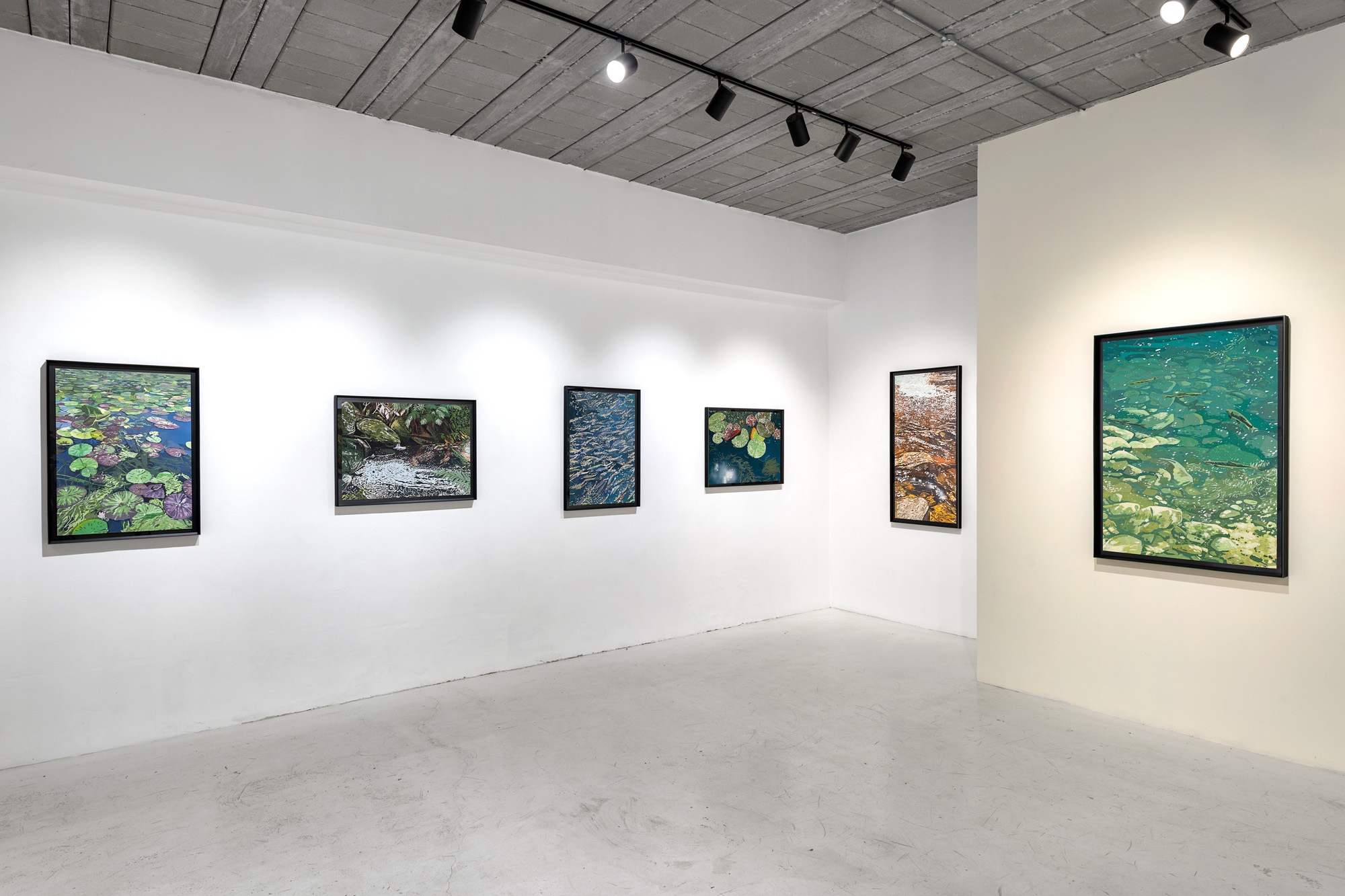 Installation shot, photo by Paris Brummer
Further Reading In Articles


African Artist Directory