

THE CONTOURS OF RETURN
INDEX: INDEPENDENT ARTIST EXHIBITION, PRESENTED BY THE NATIONAL ARTS COUNCIL
________________
Oases emerge when underground currents of water surface through a geographical fault in otherwise arid land. From this unexpected rupture, a series of incidental phenomena unfold: migratory birds disperse seeds across vast distances, winds carry organic matter into fertile ground, and unlikely vegetation begins to grow. An oasis is therefore not simply a place of refuge, but the result of convergence, movement, and conditions that allow new life to emerge where it otherwise could not.
The curatorial process behind INDEX 2026 has unfolded in much the same way. While the exhibition began within RMB Latitudes’ broader theme, Oasis, ongoing engagement with artists gradually shifted the framework toward ideas of regeneration. Through their practices, the participating artists have expanded and reshaped these notions, opening new ways of thinking about renewal, resilience, and possibility. In collaborative curatorial practice, as shaped by Latitudes’ Nina Carew Fox and Denzo Nyathi, such shifts can be both generative and destabilising. Curators often act as sounding boards for one another, creating provisional frameworks of meaning that feel resolved until challenged and transformed through deeper artistic dialogue.
THE CONTOURS OF RETURN
In thinking about this exhibition, perhaps there is no better place to begin than with the work of Mhlonishwa Zulu. At first encounter, it may not be immediately clear what one is looking at. Yet this uncertainty is precisely the point. In these early, though already richly developed works, Zulu renders fragments of recognisable imagery within expansive colour fields. Through this painterly approach, otherwise commonplace objects are made uncanny; suspended within fields of colour, they acquire an unexpected weight and presence. One is compelled to ask: what is this doing here?
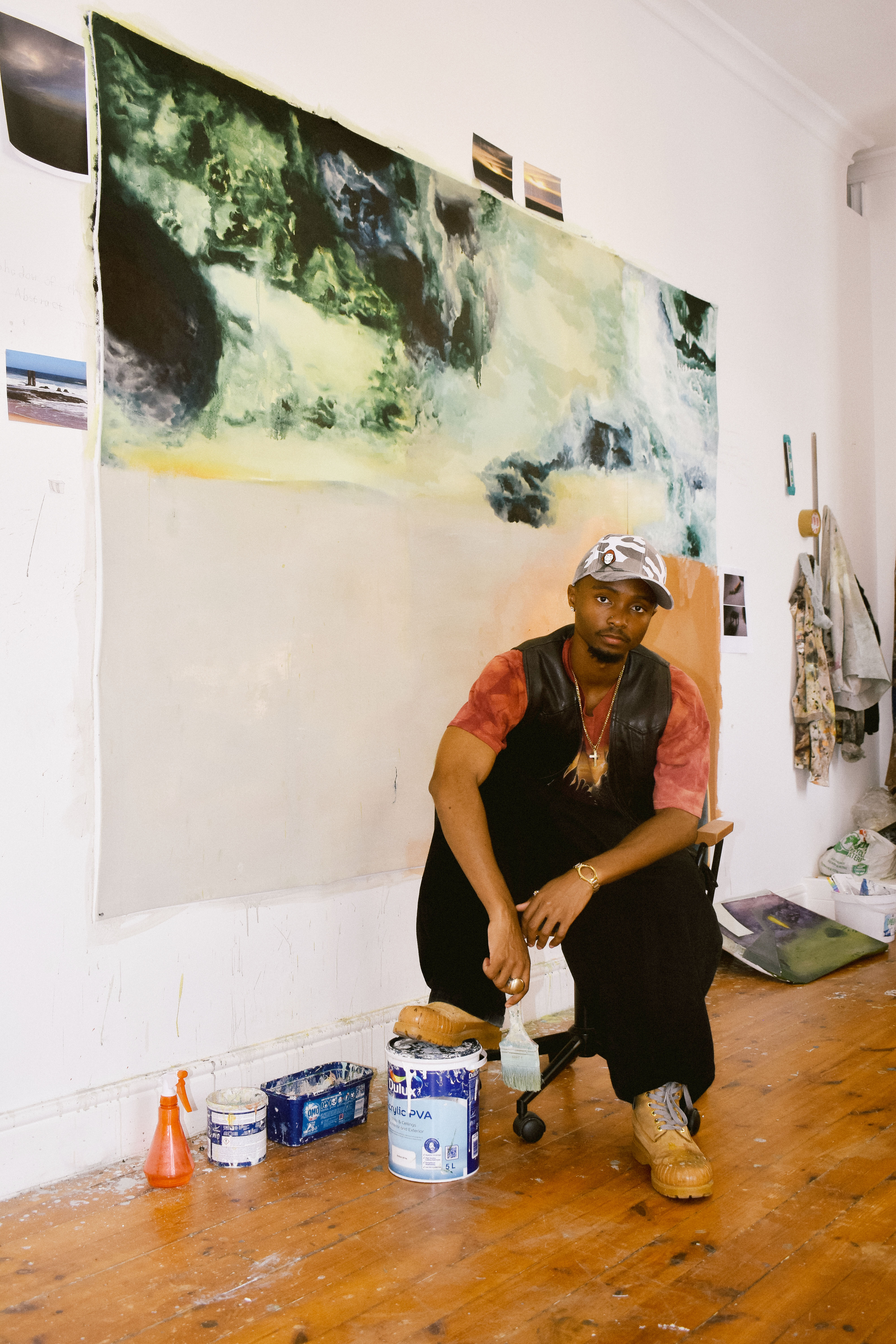
Image courtesy of Mhlonishwa Zulu.
Drawing from deeply personal landscape scenes connected to his familial home, Zulu’s practice is marked by a quiet intentionality and meditative quality. His works invite contemplation rather than resolution, slowing down the act of looking itself. In this way, they offer an important entry point into the exhibition’s thinking around regeneration. Regeneration, after all, is not a passive condition, but an active process of becoming - one defined by movement, transition, and continual transformation. Like an oasis emerging within arid terrain, it suggests the gradual accumulation of forces that make renewal possible. Zulu’s paintings hold space for this threshold state: where meaning is not fixed, but slowly forming, surfacing, and shifting before us.
Nwabisa Ntlokwana and Ditiro Mashigo draw deeply from the creative matrilineage that precedes them. In Ntlokwana’s practice, her late mother’s work as a photographer subtly resurfaces through the visual language of pixelation evident in both her meticulously layered leather works and the ridged surfaces of her wooden sculptures. Similarly attentive to the poetics of medium, Mashigo’s use of bull denim pays homage to the sartorial sensibilities of her mother and grandmother. In this sense, regeneration becomes a meditation on re: generations — the transmission, reworking, and continuation of inherited forms of knowledge and identity.
Working with natural and repurposed materials, both artists engage processes of transformation and renewal. Ntlokwana’s practice, in particular, reads as a love letter to wood, foregrounding material histories while reshaping them through artistic intervention. Across both practices, questions of preservation, decay, and permanence emerge through the reimagining of materials that carry lived and generational memory.
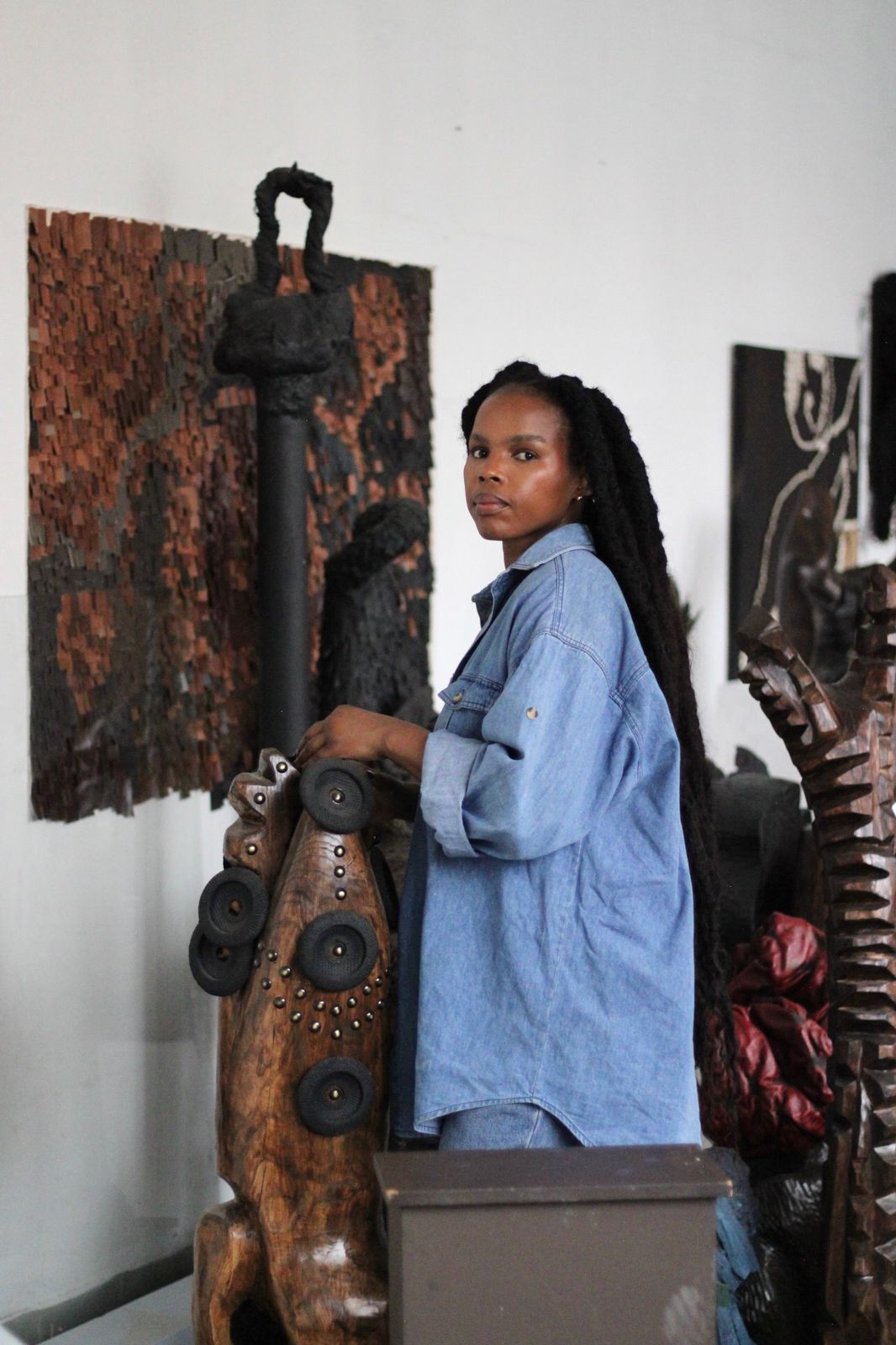
Image courtesy of Nwabisa Ntlokwana.
At the same time, both artists reflect on their relationships to matrilineal inheritance while navigating their own experiences of matrescence. Their works consider how motherhood initiates profound shifts in identity, demanding forms of transformation that require one to remake, reinterpret, and recast understandings of self across generations.
These artists raise questions of the way that life can potentially continue to flow through creative practice. This line of enquiry returns to the fundamentally ontological reflection on what lifeforce itself might be. If a number of chance happenings in nature can spring about luscious oases in climates that defy life itself, lifeforce — as a thriving and determined current of its own — is indeed a worthwhile point of consideration. Already engaged in this thinking around (Black) ontologies, Resego Sefora considers the way in which sound is not only a by-product of life lived, but shapes life itself — materially, emotionally and psychologically. In this study, one serves to benefit from a closer look at the water in Sefora’s sonic plinth.
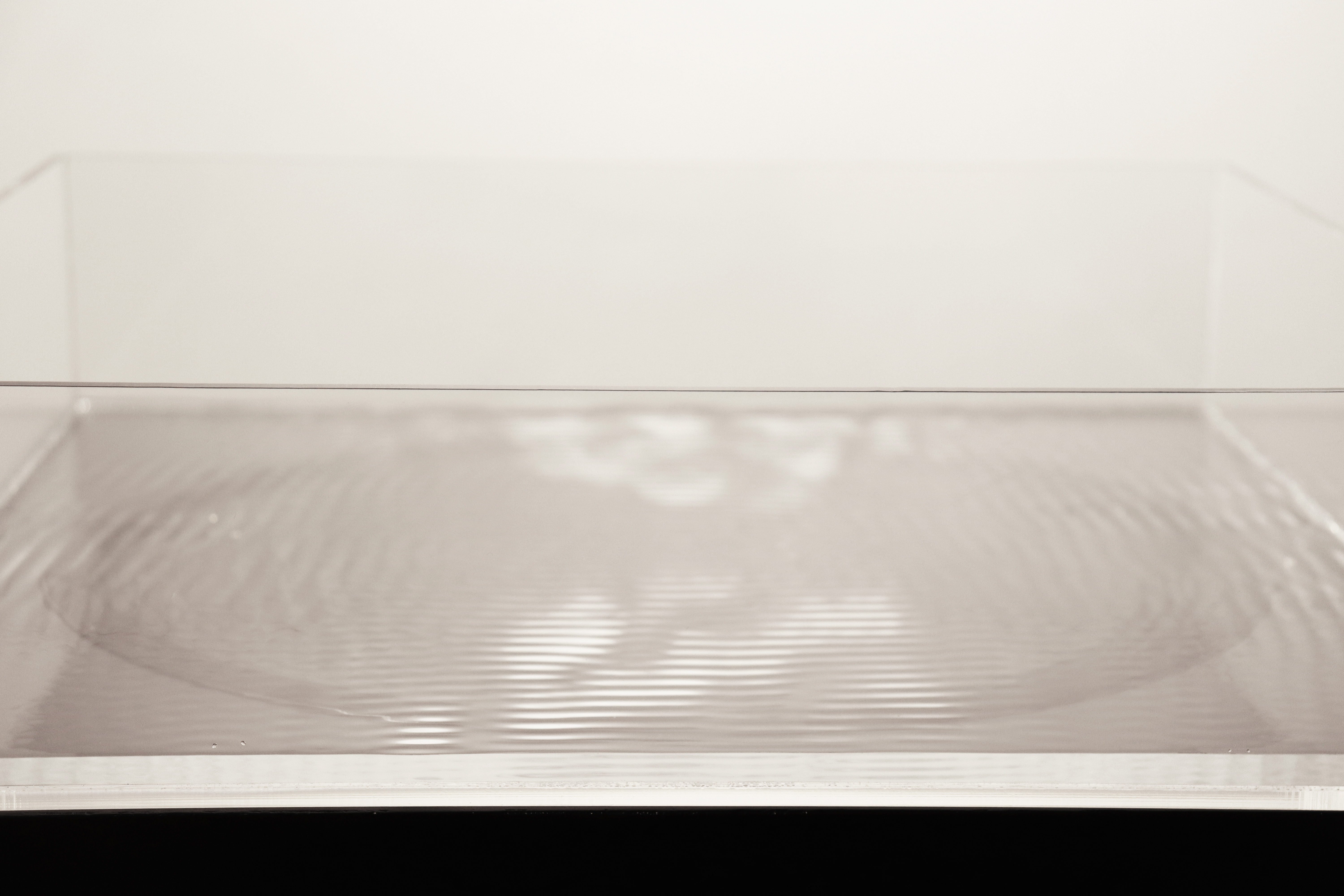
Image courtesy of Resego Sefora.
The work speaks to the regenerative capacity of the sonic - its ability to move the spirit, alter perception, and connect one to something beyond the self. Elemental in nature, the installation remains deeply responsive to its environment. Through this responsiveness, the work foregrounds sound as a shapeshifting force: invisible yet deeply affective, ephemeral yet capable of profoundly transforming the spaces and bodies it encounters.
With a similar elemental concern, Khanyisa Brancon’s work considers the life-giving force of rivers and their inevitable movement toward the sea. This seemingly simple relationship between river and ocean becomes deeply charged within the context of Palestinian resistance, where water carries political, territorial, and symbolic weight. At the same time, Brancon seeks to liberate the traditional Tsonga skirt from its prescribed realm of function, allowing it to operate instead as a vessel of memory, movement, and transformation. Through this gesture, the garment transcends its utilitarian and cultural expectations to become a material language through which questions of inheritance, displacement, femininity, and freedom are held in tension.
Vas Putter’s practice offers sustained attention to transformation, material reuse, and socio-environmental repair. Working across painting, printmaking, and assemblage, her incorporation of discarded objects speaks to cycles of breakdown and renewal, where what is cast aside is reactivated as a site of meaning. This process mirrors broader ecological and humanitarian concerns, foregrounding systems of depletion and recovery, while also tracing the historical and contemporary forces that shape lived experience. In this way, her work positions regeneration not as abstraction, but as a lived, material condition - one grounded in both memory and the possibility of reassembly.
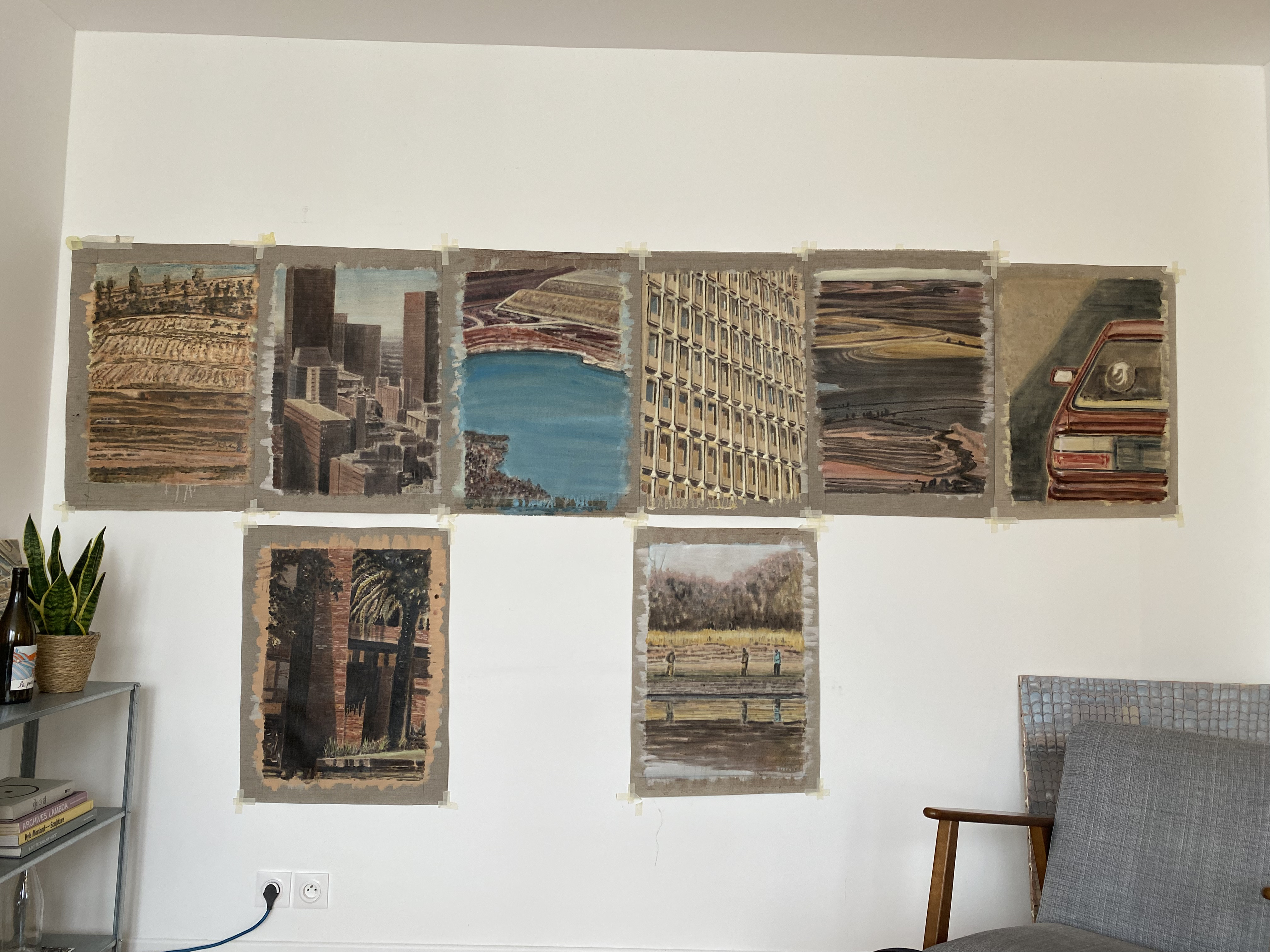
Image courtesy of Selwyn Steyn.
In Selwyn Steyn’s practice, the city emerges not simply as backdrop, but as a living archive of memory, erosion, and transformation. Through moody, nostalgic renderings of everyday scenes from the Big Smoke; fleeting moments glimpsed in daily commutes, fragments of the urban landscape, and sites such as the Johannesburg Art Gallery, Steyn draws attention to the quiet emotional weight embedded within the built environment. His work lingers in the tension between documentation and reflection, capturing spaces that feel both intimately familiar and subtly estranged. Material sensitivity becomes central to this process: surfaces, light, atmosphere, and architectural form operate as carriers of memory, revealing how cities absorb histories long after more fragile traces have disappeared. In this way, Steyn’s practice resonates deeply with INDEX 2026’s consideration of regeneration, suggesting that urban environments themselves are continually rewritten through presence, absence, and the layered accumulation of lived experience
This is especially resonant in relation to Johannesburg itself, a city shaped by uneven histories of extraction and migration, and by the labouring bodies that physically constructed and sustained its urban form through the mining economy at its origin.
The inclusion of Marlise Keith, Shana Ellappa, Nomvula Hoko, and Mncedisi Mkhize within the Latitudes Online component extends INDEX 2026’s curatorial framework of regeneration into the digital sphere. In this context, online presentation becomes more than an alternative mode of exhibition; it functions as a parallel ecology in which visibility, access, and circulation are reactivated beyond the physical constraints of the fair. For these artists, the online platform enables works to reach dispersed audiences, generating new forms of encounter that are not bound by geography or institutional proximity. This shift mirrors the exhibition’s broader thinking around regeneration as an ongoing process of renewal, where creative practice is continuously re-energised through different systems of exposure, interpretation, and exchange. In this sense, Latitudes Online becomes a site where artistic presence is not diminished by distance, but instead reconstituted through expanded networks of engagement.
OASES OF EXCHANGE: Public–Private Collaboration in INDEX 2026
Furthermore, this year’s edition ushers in a partnership with the NAC, marking a considered shift in how public arts funding intersects with the structures of the contemporary art market. Together, INDEX and the NAC propose a progressive model for aligning institutional support with tangible, market-facing opportunities for artists – extending the NAC’s role beyond grant-making and into a sustained ecosystem of visibility and exchange.
Presented across both the physical fair and Latitudes Online, INDEX 2026 brings together a dynamic selection of emerging artists from across the continent. The exhibition features a curated presentation shaped within the Latitudes programme, alongside artists identified through the NAC’s open call process.
In this sense, regeneration is not approached solely as a conceptual theme, but as an active methodology; a bringing into existence once more through collaboration, exchange, and renewed systems of support. Within the South African context, regeneration carries particular resonance. It speaks to the continual reimagining of cultural infrastructure, to the resilience of artists working independently and often without sustained institutional backing, and to the necessity of creating new pathways for visibility, dialogue, and sustainability within the arts ecosystem. The Contours of Return speaks to the continual reimagining of cultural infrastructure and to the resilience of artists working within conditions of experimentation, limited resources, and diverse lived realities.
The partnership between RMB Latitudes and the National Arts Council reflects this movement toward renewal. Through the meeting of public and private investment, INDEX becomes more than an exhibition platform; it becomes a site through which different forms of support, advocacy, and cultural responsibility intersect. The exhibition embodies a collective commitment to nurturing independent artistic practice, recognising that regeneration within the arts cannot occur in isolation, but through ecosystems built on reciprocity, access, and shared belief in the value of creative production. Like an oasis formed through unseen currents and incidental convergence, INDEX 2026 emerges through the coming together of artists, institutions, curators, and audiences, each contributing to the conditions necessary for new growth to take root.
PARTICIPATING ARTISTS
Selected for the INDEX booth presentation and Latitudes Online exhibition:
Ditiro Mashigo, Vas Putter, Nwabisa Ntlokwana, Resego Sefora, Selwyn Steyn, Mhlonishwa Zulu and Khanyisa Brancon
Selected for the Latitudes Online exhibition component:
Marlise Keith, Shana Ellappa, Nomvula Hoko, Mncedisi Mkhize
RMB Latitudes’ Curatorial team: led by Nina Carew Fox and assisted by Denzo Nyathi.
Further Reading In Articles


African Artist Directory