
Nigeria’s Cultural Reckoning
- By Mary Corrigall
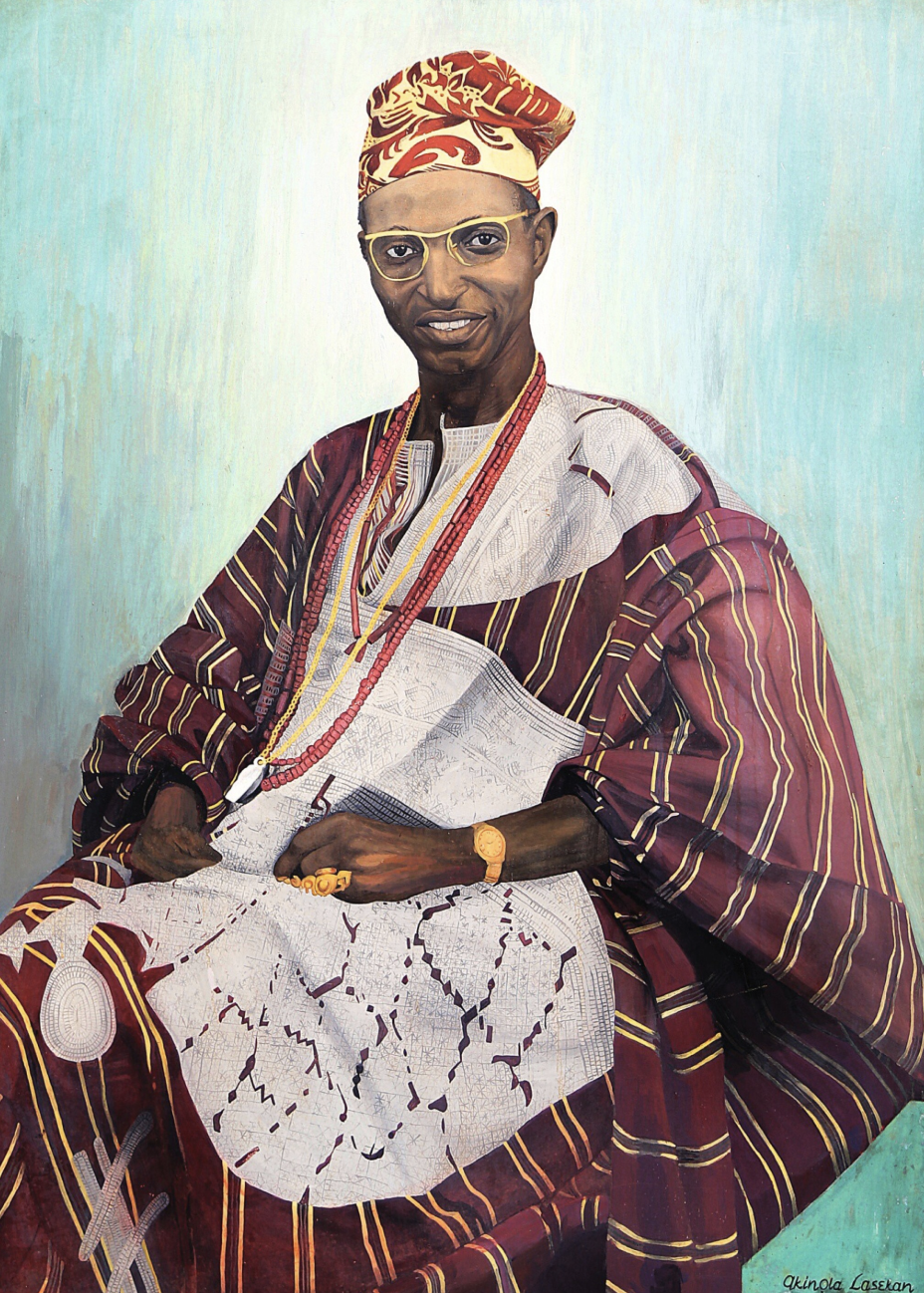
Akinola Lasekan's Portrait of Chief JD. Akeredolu (1957), photo courtesy of Sothebys
-------------
Works by Nigerian modernists such as Ben Enwonwu, Yusuf Grillo, and Ladi Kwali, among others, have most often headlined African Modern and Contemporary sales in London auctions at Bonhams or Sotheby's. As a result, this was frequently our first introduction to Nigerian modernism for those of us in South Africa, London, and other places. From this perspective, it feels fitting that a prominent exhibition dedicated to Nigerian Modernism has been showing at the Tate Modern in London.
Indeed, in the absence of a robust secondary market for historical Nigerian works of value in that country, London has functioned as a trading hub. There is a substantial Nigerian expat community in this city, which includes artists with works in this exhibition (Uzo Egonu), and, importantly, a number of galleries dedicated to Nigerian and/or African art, such as Tiwani, Rele, and Signature, are based here. Contemporary spaces in Lagos - such as Affinity and O'da in recent years - regularly participate in the 1:54 London art fair.
With 150 works by 50 artists, an historical exhibition of this breadth at such a respected institution is long overdue, providing context for modern and contemporary Nigerian art that is shown and sold in this city and elsewhere. In short, an exhibition of this nature is likely to bolster Nigeria's profile as an art centre on the African continent.
Much like The Casablanca Art School: Platforms and Patterns for a Post-Independence Avant-Garde (1962–1987), which was showcased at Tate St Ives in 2023 and positively influenced the Moroccan art scene, Nigerian Modernism is also expected to have a similar effect on its own local art community. The newly established Museum of West African Art (MOWAA) in Benin City may attract increased attention, especially as exhibitions exploring this particular period of art are likely to become more clearly defined over time. This significant exhibition is best seen as the beginning of many future events- ideally including stops in South Africa, where the focus often remains narrowly on local art history, even though Nigerian artists and galleries have become regular fixtures at our art fairs.
When you visit this exhibition, you can't help but wonder how this story might play out differently in Nigeria. Has the development of modernism in this nation been oversimplified for audiences who are primarily Western? The development of modernist language, as influenced by Enwonwu, Aina Onabolu, Kenneth Murray, and later Uche Okeke - as examined in Chika Okeke-Agulu's Postcolonial Modernism: Art and Decolonisation in Twentieth-Century Nigeria (2015) - reveals a nuanced and non-linear narrative. The evolution of modernism is shaped by varied perspectives and approaches that challenge purely chronological interpretations. This is reflected in the exhibition’s first gallery, where works from the 1950s appear alongside those from the 1920s.
Nevertheless, as most of the leading figures tended to articulate their positions through their art, the competing notions underpinning a modernist language can be traced visually. Onabolu’s approach was defined by a complete break with traditional African arts in favour of Western academic easel painting - this is also demonstrated through striking portraits by Akinola Lasekan. Enwonwu’s style and subject matter were varied: he was a master of academic portraiture, but he also employed radical stylisation to capture what he felt was the ‘spirit’ and ‘rhythm’ of traditional Africa. Though it was rewarding to finally see in person his famous dancing figures - not just of women but also costumed rituals, which are evocative and colourful - it was a landscape painting, Road to Siloko, Benin (1943), depicting a forest scene with significance in Onitsha cosmology, that stood out as a less obvious example of how his stylisation and depiction of African ideas were channelled through figurative painting. Enwonwu established a dark palette, though he worked with reds, yellows and blues, and an expressive language that appears to have laid the foundation for an aesthetic traceable in Bruce Onobrakpeya's Tree in Landscape (1963).
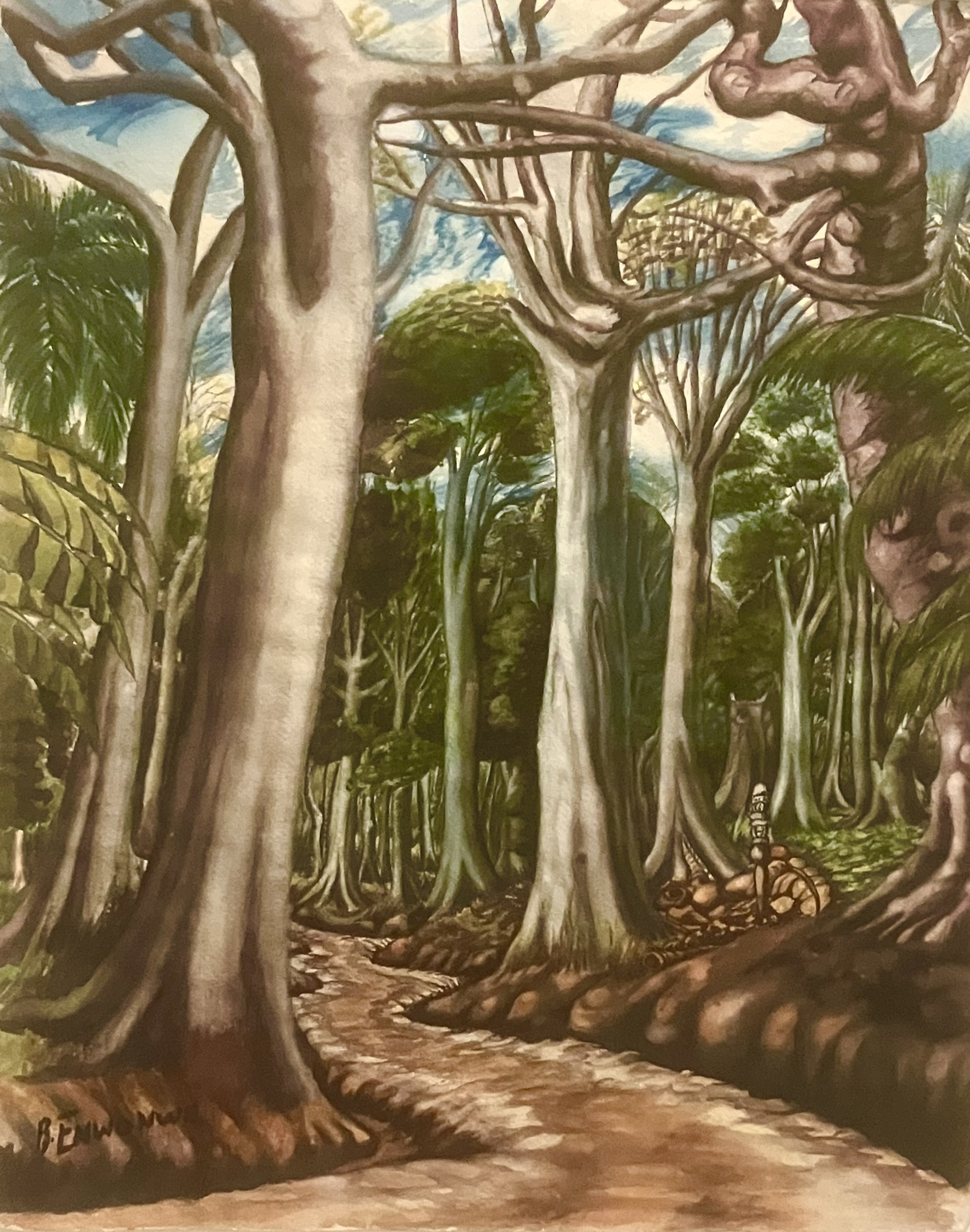
Ben Enwonwu's Road to Siloko, Benin (1943), photo by Mary Corrigall
Enwonwu became a critic of pure abstraction, viewing it as a mimicry of European trends that led Nigerian artists into an "abstract jungle" away from their cultural roots, whereas Okeke led the "independence generation" and proposed the theory of Natural Synthesis, which involved the purposeful blending of indigenous African artistic resources - specifically Igbo Uli (traditional body and mural drawing) - with Western technical methods. These differing perspectives indicate that modernism in Nigeria developed through a process of negotiating the relationship between indigenous cultural traditions and Western painting practices.
In this way, while modernism in Europe was driven by a compulsion to divorce art from politics, pushing for a language that was in conversation with itself, in Nigeria and other African countries it was a political act, as the painting tradition was burdened by colonialism and European cultural imperialism. Painting can never be apolitical in this context, a position that arguably offers a more realistic view of art-making or history.
The story of Nigerian modernism runs parallel to political developments in the country. In the early twentieth century, artistic styles were directly influenced by an antagonism towards colonial ideologies. Onabolu’s adoption of academic realism was a revolutionary political gesture intended to prove that Africans possessed the same intellectual and artistic capabilities as Europeans, thereby undermining myths of African inferiority. The peak of Nigerian modernism coincided with the final push for sovereignty, with artists inspired by the rhetoric of Négritude and Pan-Africanism.
The Art Society at Zaria, founded in 1958, functioned as an artistic avant-garde that mirrored the political decolonisation process. Nigeria's Independence Celebration in 1960 was marked by a landmark art exhibition where modern art moved from the margins to the centre of the national imaginary. Murals like Uche Okeke’s Mother Nigeria were commissioned specifically to symbolise national unity during the independence celebrations.
This mirrors South African art history to some degree, though the time periods don’t align (our liberation came much later)- with art focused on overturning an oppressive system before democracy ignites a cultural revolution, manifesting in a search for a post-independence identity and the restoration, revaluation and decolonisation of art and indigenous traditions.
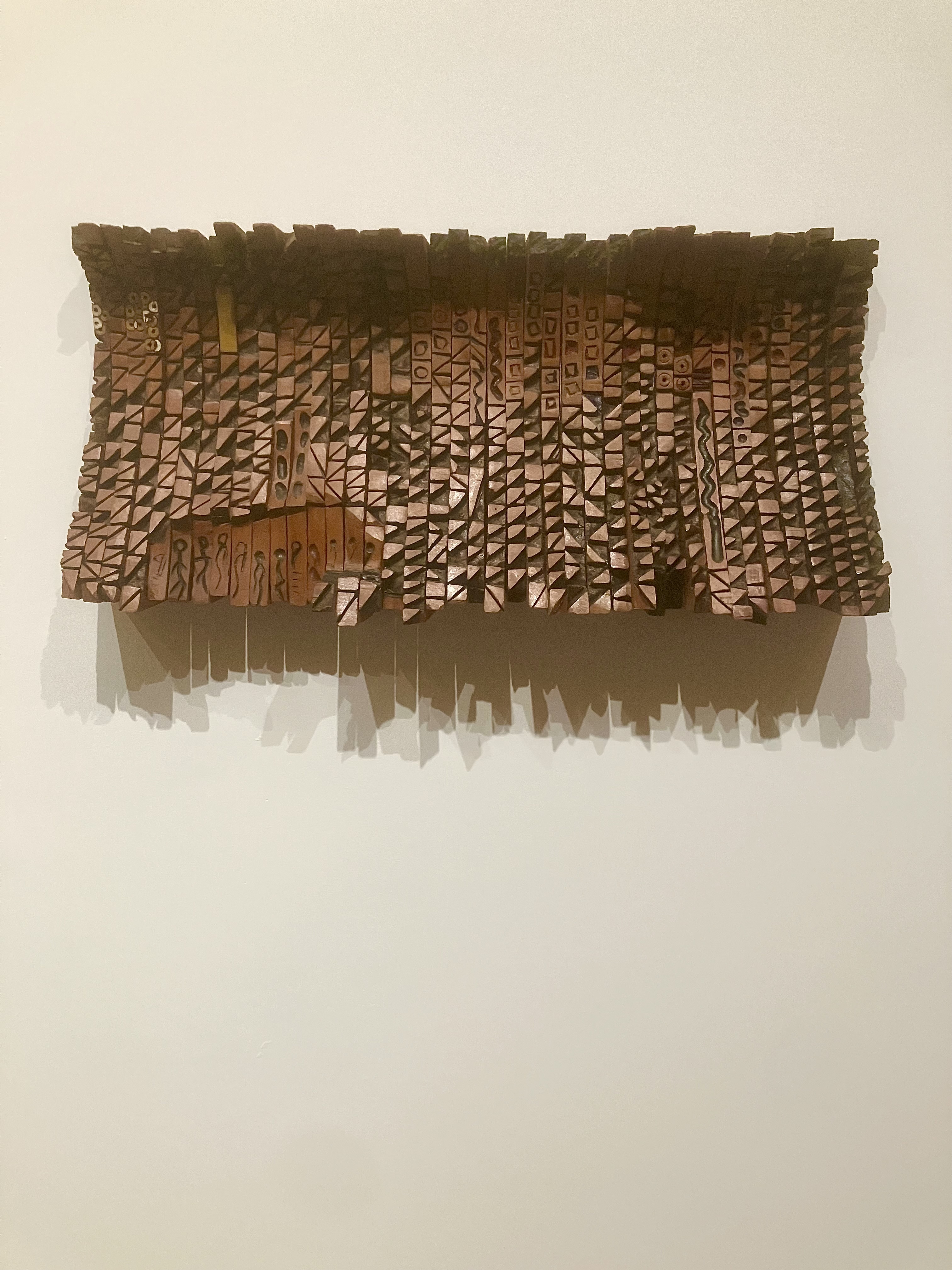
El Anatsui's Earth Moon Connections (1993), photo by Mary Corrigall
The exhibition vacillates between a focus on specific artists and different schools of art-making from the 1920s to the 1970s. It opens with Enwonwu as an introduction, followed by a gallery dedicated to Kwali's pottery. It then explores broader themes through the works of the Zaria Art Society and demonstrates how modernist aesthetics influenced architecture and cultural life in Eko (Lagos), featuring images of buildings alongside photographic works by J.D. Okhai Ojeikere illustrating its impact on hairstyles. The progression continues through the New Sacred Art Movement of the late 1950s, as well as the Oshogbo and Nsukka Schools, before concluding with a final artist focus on Egonu.
Given the ongoing dialectic between Nigerian cultural traditions and Western painting, the exhibition might have benefited from a more comprehensive introduction to dominant traditional works and visual aesthetics of the past, as well as texts outlining spiritual belief systems.
Though I had an awareness of Okeke’s role in driving a modernist practice, I hadn’t fully grasped the breadth of his impact and importance. After the Nigerian Civil War, Okeke became head of the art school at Nsukka and formally institutionalised the theory of Natural Synthesis. While he advocated for an intellectualised approach, emphasising research and the adaptation of Uli and other West African graphic forms, it is also illuminating to consider the opposing position of the Oshogbo school, facilitated by Ulli and Georgina Beier, which favoured an informal, experimental approach over formal academic training.
The results are compelling mythological figures, most strikingly exemplified in the large-scale painting by Twins Seven Seven, Condemning Witchcraft – Red Skulls (1968). The eyes of hybrid beings—animals and people—stare out from an earth-toned canvas, revealing an intertwining between nature and humanity. It’s almost as if the earth is alive with spirits!
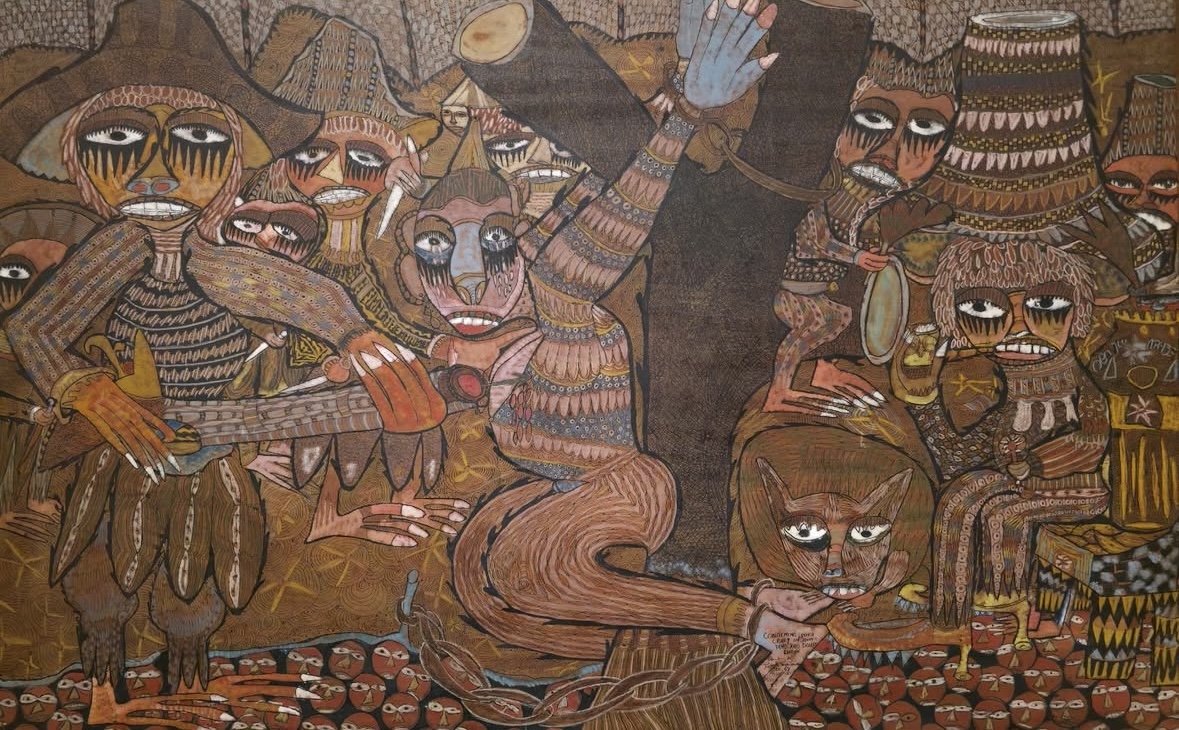
Twins Seven Seven, Condemning Witchcraft – Red Skulls (1968)
Earthy tones, complemented by abstract shapes in red and yellow, define another striking work in the exhibition: Obiora Udechukwu’s Our Journey (1990s). It presents the unfurling of a yellow ball containing figures and abstract forms, hinting at the unravelling of time or history, in much the same way this exhibition seeks to do. Produced in the 1990s, the work signals, so to speak, the endpoint of the ideological thread that shaped Nigerian visual expression. The legacy of these various modernisms could have been more fully unpacked; concluding the exhibition with a solo presentation of Egonu’s synthesis of abstraction and figuration feels like an unsatisfactory ending.
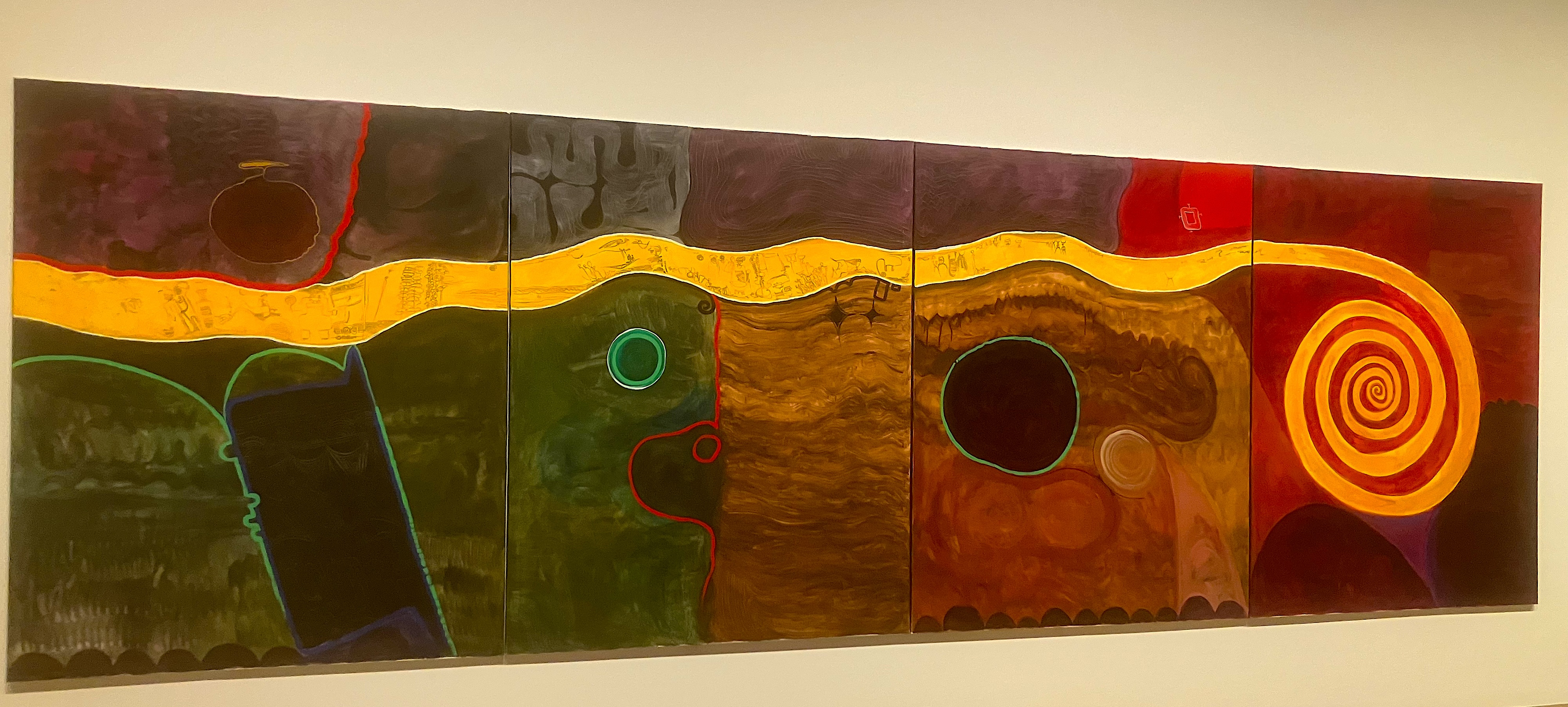 Obiora Udechukwu, Our Journey (1990s)
It may have been interesting to consider the dominant expressive modes and subjects embraced by contemporary Nigerian artists, particularly women - given how few are included in the exhibition - and how their practices are informed by African spiritualism, traditions or aesthetics.
Artists such as Wura-Natasha Ogunji, whose recent London exhibition referenced the Gelede mask from Yoruba ritual traditions celebrating women and mothers, or Bunmi Agosto, whose visual language draws on ancestral knowledge, spiritual consciousness, cultural theory, graphic novels and gaming, come to mind. But perhaps that is another story; one in which ancestral tradition is assumed as intrinsic to visual expression, without carrying the political weight it once did, as the boundaries between Western and African art continue to blur.
Nigerian Modernism: Art & Independence shows at Tate Modern until May 2026.
Corrigall is a Cape Town based commentator, consultant, researcher and director of the HEAT Winter Arts Festival
Further Reading In Articles


African Artist Directory