

Canvas, concrete and ways of seeing
Having a foot in architecture has given Selwyn Steyn perspective, writes Tom van der Schijff

During a Zoom call from Pretoria-born Selwyn Steyn’s Paris home, to discuss works for the HEAT Winter Arts Festival, which he is showing at Proximate World at Untitled Art’s exhibition, it’s obvious this friendly creator has many sources of inspiration. Rather than competing, his work as an architect and artist overlaps and informs itself; neither discipline dominates the other. The result is a practice unique to Steyn, reflecting his perception of the world, candidly expressed through oil paintings of the urban spaces he frequents.

I think my practice is more solitary. From time to time, there are these group shows and things in which you have to rally with the old community, but I actually think I’m quite isolated partially because I’m based in Paris, but also because I’m in two industries at the same time
Informed by his career in architecture, Steyn uses buildings and their place in a physical environment as sources of inspiration for his work. However, beyond the buildings being subject matter portrayed on paper, Steyn’s paintings record how he sees and experiences urban surroundings.
“It’s a direct experience kind of thing. And the fact that the subject matter happened to be a lot of buildings and urban spaces was just a reflection of the fact that, often, having been trained in architecture, that was naturally what my attention sort of gravitates towards,” he said.
Unlike the precision of architectural drawing and its crisp linework, Steyn’s buildings are conveyed with a gentle, clearly hand-done approach. Although primarily oil-based, the heavily diluted colours bring to mind watercolour illustrations of botanical art, yet applied to urban scenes. Just as art and architecture are often thought of as separate entities, the same can be said for natural and urban environments - and yet, Steyn finds links that bridge the two.
“Many of the buildings in Gauteng are modernist buildings that were built in the 20th century during Apartheid. Because of international sanctions, South Africa was quite cut off, so everything was sourced and created locally. Concrete was made in South Africa, using South African building sand. The quality of the earth is physically visible in the built environment as well. These buildings are very distinctively of this place.”
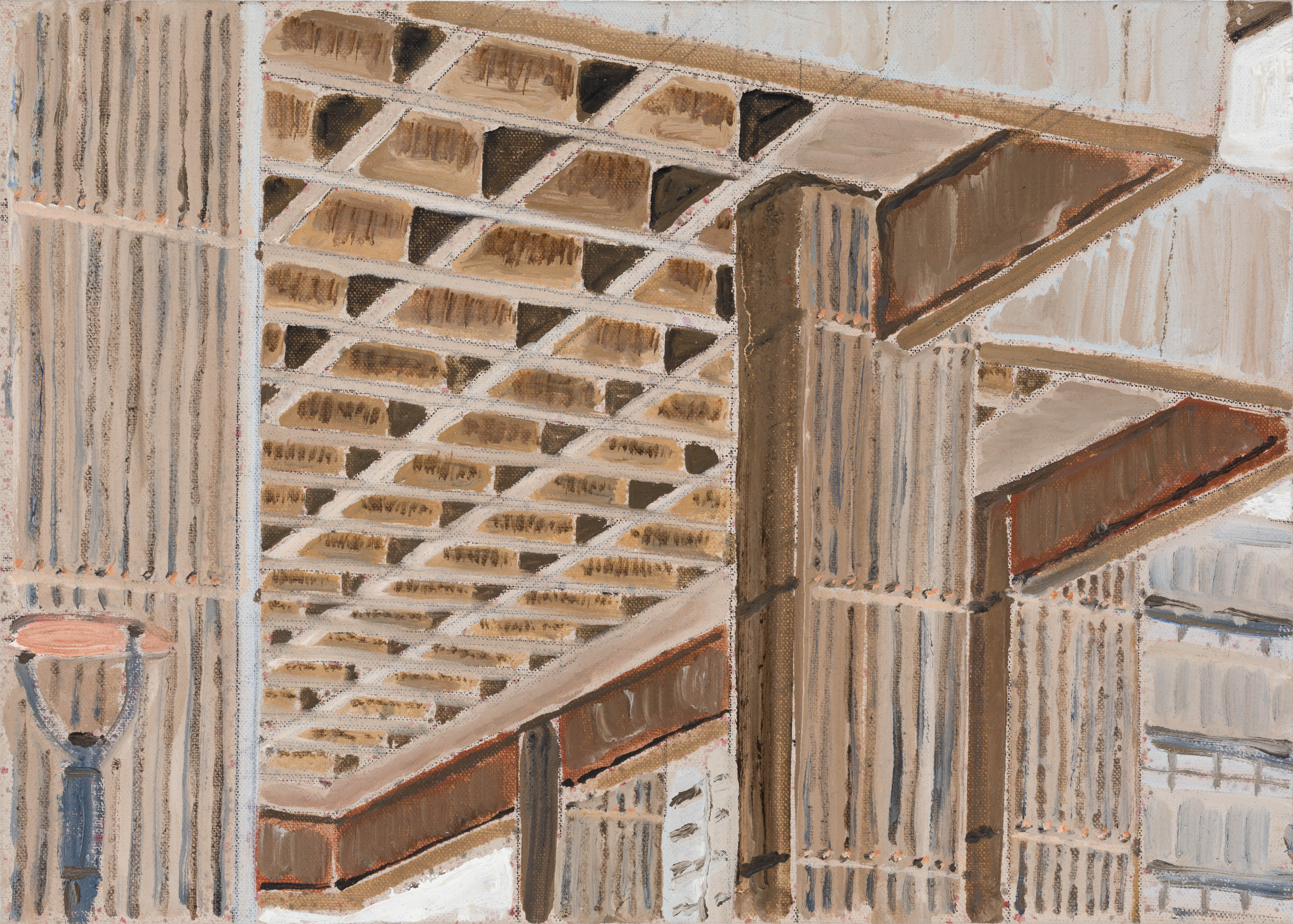
Selwyn Steyn, Insurance buliding, oil on linen, 36 x 25 cm
Further than showing how the buildings he paints bear the physical imprint of their local materials and historical context, his approach to painting carries an awareness of how time and atmosphere shape our perception of place.
“This idea was explored quite successfully by the Impressionists, for instance, when they would paint the same haystack, or the River Thames, at different times of the day, and different seasons.”
As part of the 2024 group show Space Register, Steyn created three paintings of the same building across the street from the RESERVOIR gallery in which the show was staged. Painted at three different times of the day, the same subject matter is shown to have different levels of light and colour, depending on the hour. A man made building, thought to be static and unmoving, is shown to not be exempt from the natural element of time and the change it brings.
These three works, Looking out from Reservoir (warm day, mid day), Looking out from Reservoir (cold day, mid day) and Looking out from Reservoir (warm day, overexposed), were not displayed against a gallery wall, but rather suspended, or wedged midair in the gallery space by steel scaffolding ascending and sinking from the floor and ceiling. It is fitting that the awareness of space with which Steyn approaches his work should extend beyond a depiction on a canvas and manifest in how the works are positioned in a room. By inserting the works as physical objects at risk of being bumped into, the viewer is invited - or confronted - with the idea of the pieces as more than images of a building, but studies of dimension.


Steyn’s focus on how we see the world has a unique relationship to the 2025 HEAT Winter Arts Festival theme of Other Worlding. Though other artists have found commendable success approaching this theme by speculating how the world might look if it were other, Steyn draws attention to other ways of looking at the world. An attitude of being passive to surroundings is rejected in favour of an intentional awareness.
“My practice is based on perception and direct experience. It’s almost the most anti-conceptual practice you can imagine.”
Looking at the often overlooked has given Steyn a surprisingly rich source of insight. This spatial sensitivity is strengthened by his position between two disciplines, enabling him to have a unique perspective that is independent and uncompromised by external pressures.
“I envision myself remaining in both industries. I definitely would not want to completely jump just into one or the other one because there’s a benefit in not being 100% fully in the art world. I think it allows me a degree of independence, to be able to remove myself and not be completely just immersed in only that. It allows me to create presentations on my own terms, when it’s projects that I really care about. It works favourably for me to be able to remain candid and show a point of view that is my own, that’s not influenced by any pressing concerns.”
Steyn’s festival works will be presented by Untitled Art’s exhibition Proximate Worlds. Visit: www.heatfestival.org
Further Reading In Articles


African Artist Directory