

Ancestral, archetypal and nonlinear: The liminal work of Balekane Legoabe
In her work for the HEAT Winter Arts Festival what one finds is a state of suspension between worlds, between past and present, between here and there, between the known and unknowable, writes Nkgopoleng Moloi
Ahead of the exhibition, Evidence of things not Seen to be staged at EBONY/CURATED as their Heat Winter Arts Festival exhibition, I met with Balekane Legoabe in her studio, situated at her home on a quiet street in Cape Town. She welcomes me warmly, offering something to drink and chit chatting about her experiences of living in the city. The weather is cold, a brooding kind of day when everything appears grey, unappealing and melancholic. This is in contrast to what I’m about to experience as her practice is fresh and full of energy, yet somehow also subtle and warm. After settling in with a brief conversation about how she’s adjusting to the city, having moved from Johannesburg months earlier, we delve into the heart of our discussion. I tell her one of the greatest joys for a writer is discovering work for the first time and genuinely connecting with it, finding resonance in the marks, gestures and moments that make up the compositions.
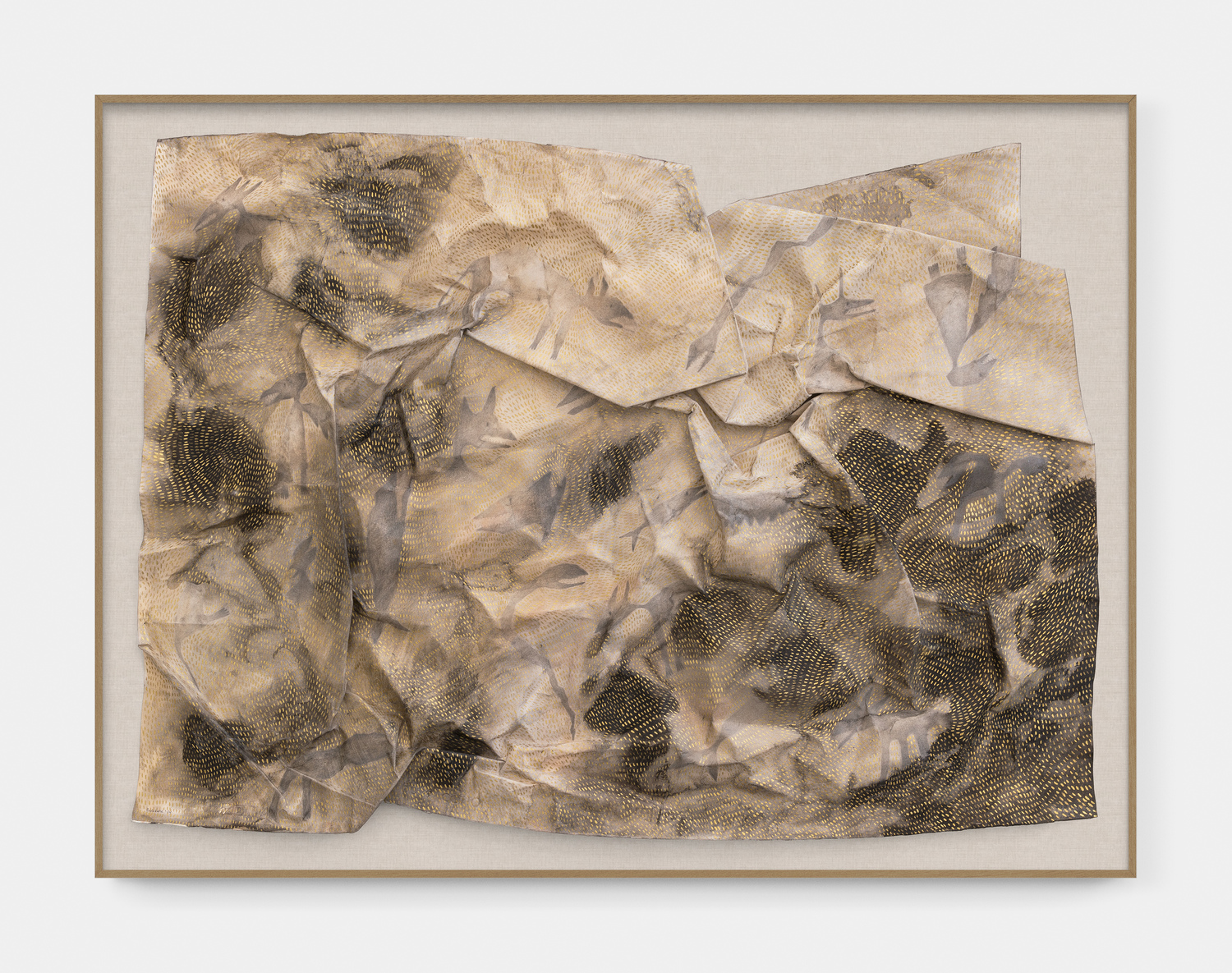
Copy of BALEKANE LEGOABE (1995- ) Remnants- of Sealing. 2024. Watercolour, Ink and Graphite on Fabriano. 68.5 x 96.5 x 3.5 cm - Ebony Curated
To think of Legoabe’s practice is to think of “hovering” - hovering as an alternative to thinking about multiplicity in more conventional terms. Because multiplicity suggests distinct and countable forms coming together as one. In her work, what one finds is a state of suspension between worlds, between past and present, between here and there, between the known and unknowable. It’s what I can only describe as “hovering”, a temporal suspension and productive tension. The work’s quality refuses interpretation, instead existing in the liminal spaces where meaning shifts and transforms, much like the geological memory she speaks of exploring.

Lately in my work, I feel that there is a knowing that feels grounded - not only that I know, but that other people know too - Balekane Legoabe
Legoabe works across digital art, printmaking, drawing and, more recently, painting, but she says “paper is where she feels at home”. She engages the properties of paper, materially and conceptually, teasing out its hidden potential.
For the last few bodies of work, such as in her solo exhibition Things That Are My Own at EBONY/CURATED, her process has involved a multilayered approach to “treating” paper that begins with washing over it with acrylic paint, applied in a liquid, almost dripping state, and crumpling it into a bundle. Once unfolded, the paper becomes her working surface, transformed by the crumpling process into something resembling a rock or some other kind of precious metal. This technique - a method and metaphor - speaks of unfolding fantasies, dreams, and ideas that make up her practice. The paper retains the memory of what has been inflicted on it, but in that process transforms into a new kind of potentiality. I can’t help but think of this alongside the complex geological processes that result in rock formations over millennia, contained in singular objects that seem to carry the heavy weight of deep time. Her work, too, seems to carry the weight of history, whether it is in depictions of wild and fantastical animals or human figures that morph into each other, or lines and dots that form themselves into geometry.
There is a repeated, performative constitution of gesture in how Legoabe works. Once the surface is sufficiently prepared, she inscribes large and small notations on it, either through identifiable forms or more intuitive markings, until the composition “feels right”. What is impressive is the work’s openness and how it allows for multiple interpretations to coexist. Maybe this is a head, or a fish, a child or a fragment of a random doodle.
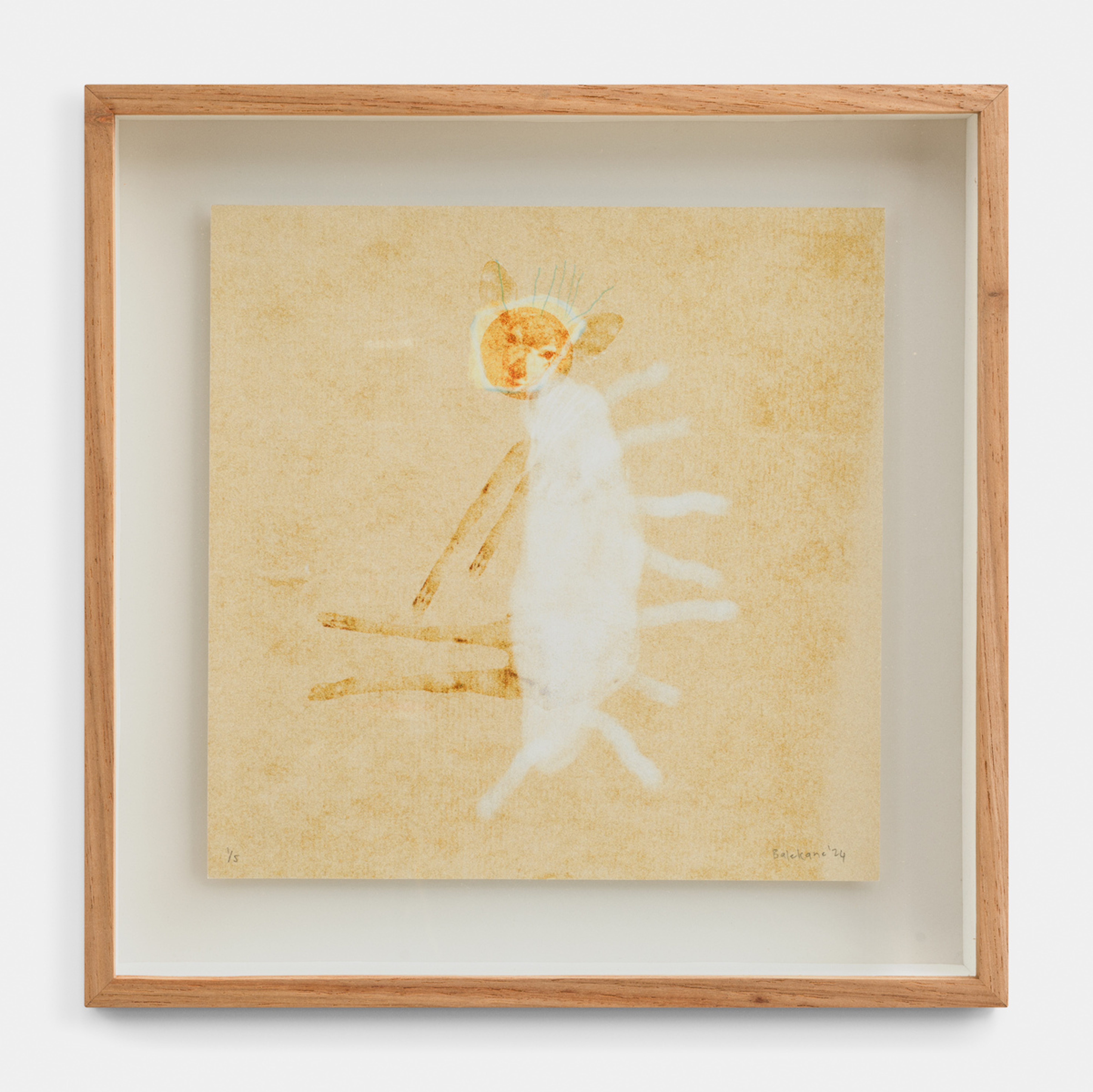
BALEKANE LEGOABE (1995- ) Sun Bby _ Ed. 2 of 5. 2024. Digital Print on Archival Paper. 21 x 21 cm
When I consider the theme of Other Worlding, presented as the narrative spine that brings together the ideas and inquiries of this year’s HEAT Festival, Legoabe’s work sits squarely within this territory. She engages ancient and present histories while making space for the possibility of what others might refer to as “third spaces” (to think with the theorist Homi K. Bhabha) or states that make space for the integration of the real, imagined and lived (as per Edward Sosa’s notion). Her compositions bring together geometry, animals and plant life while emulating the rich tonalities of fertile soil and minerals found deep within the earth’s crust.
While she draws on dreams and dream states, Legoabe says a book that has been foundational to her of late is The Moon as Shoe: Drawings of the San/Der Mond als Schuh: Zeichnungen der San. Published in English and German, the book brings together a collection of 229 drawings and watercolours created between 1875 and 1881 by six San artists, all informants of philologists Wilhelm Immanuel Bleek (1827-1875) and Lucy Catherine Lloyd (1834-1914) who were working in Cape Town at the time. This text provides a crucial link to some of the visual traditions that inform Legoabe’s contemporary practice - cave paintings of flora and fauna.
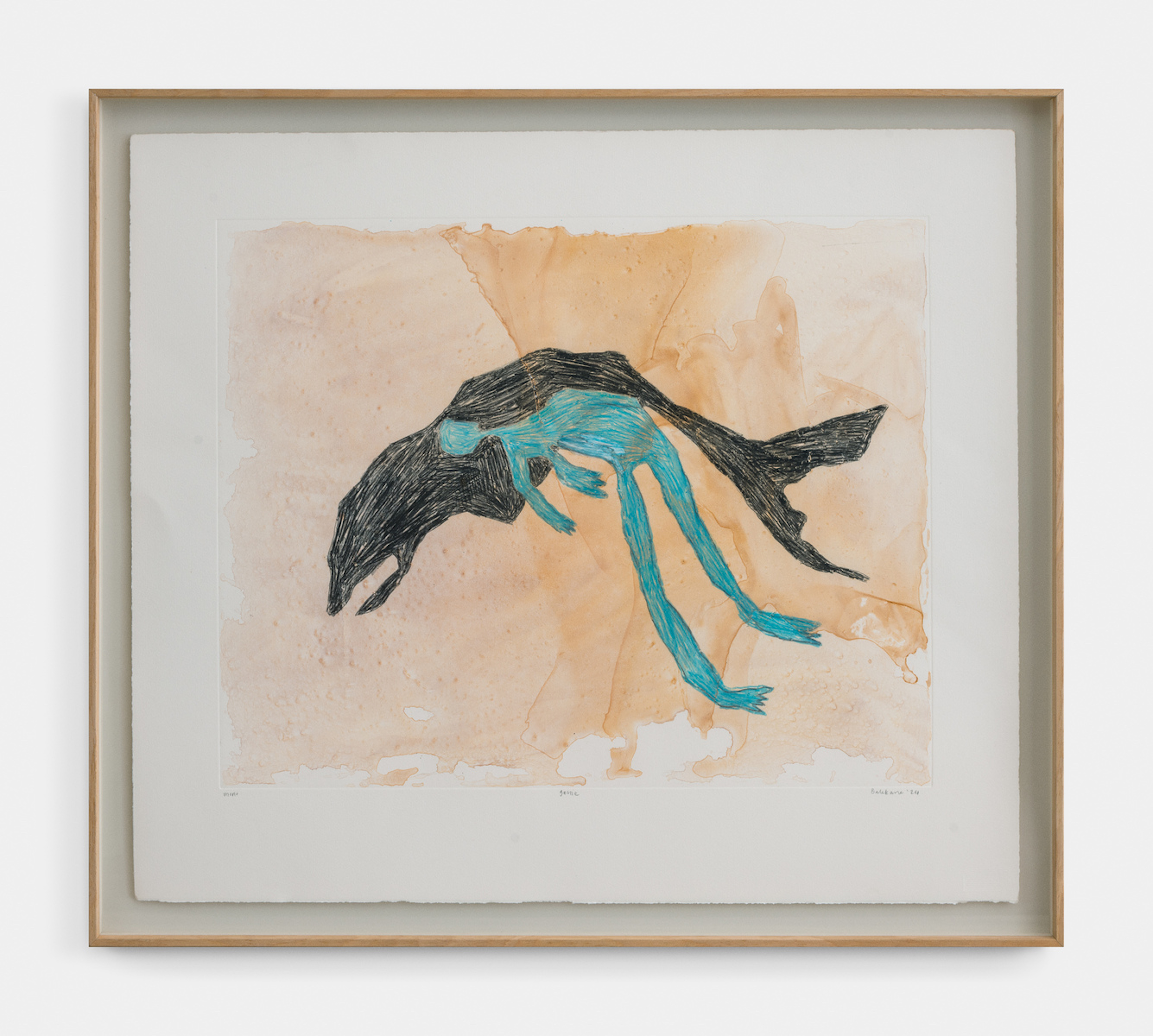
BALEKANE LEGOABE (1995- ) Genie. 2024. Watercolour Monotype on Acid-Free Paper. 54 x 61.5 cm
Looking at her images, certain qualities emerge with consistency. The work is often monochromatic or limited to two tones. It is rich in texture and tactile quality, and is characterised by a sense of fluidity that suggests geological and astrophysical processes taking shape. It appears simple and clear, and yet it is also complex and generative. Although her earlier work engaged directly with San rock art, drawing from the artistic tradition of cave paintings, her fascination also extends to symbolism. This time, the repeated symbol of the circle, a shape without beginning or end, suggests completeness, eternity and infinity. Read as the sun, the moon, and everything in between, this simple gesture can perhaps be drawn out to speak to the interconnectedness between any and all things.
When I ask how she situates her practice and what she believes the work is trying to achieve, Legoabe points me to the idea of the liminal, as a way to connect ancient knowledge systems embodying a different kind of knowing - “lately in my work, I feel that there is a knowing that feels grounded - not only that I know, but that other people know too”, she says.
In Legoabe’s work, Other Worlding - proposed as futurity within deeply speculative practices and knowledge production that draws from the past in the act of (re)imagining a future - is constituted in inscriptions of ink, charcoal and paint, that offer a tiny glimpse into ways of experiencing other. By reaching toward the ancestral, archetypal, and nonlinear, Legoabe stretches boundaries, delving into divergent and intersecting ways of being. This text was first published in HEAT: EMERGING ARTISTS YOU SHOULD KNOW. Visit www.heatfestival.org
Balekane Legoabe will exhibit at EBONY/CURATED
Further Reading In Articles


African Artist Directory